
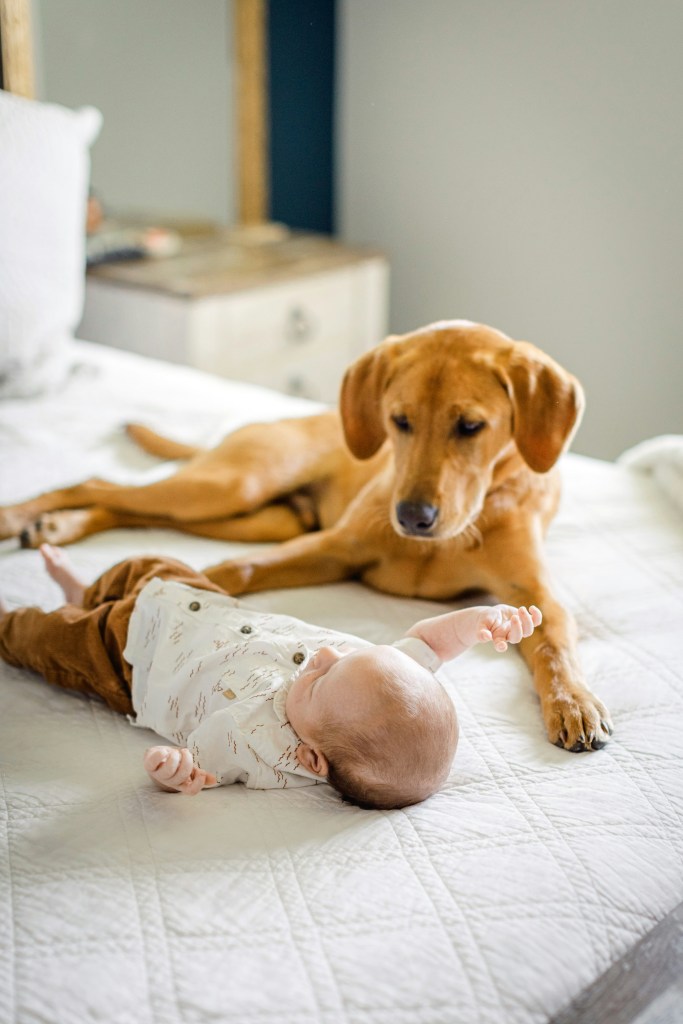
If you are expecting or have just added a new baby to the family, you may be wondering what can be done to ensure your furry family member has an easy transition to becoming a big brother or big sister. It is best to begin working with your dog BEFORE the baby arrives! This way he has ample time to get used to one or two changes at a time instead of being bombarded with new sights, sounds, and smells all at once.
Desensitize your dog to baby sounds by playing clips of a baby crying (can be found on YouTube) through your phone. Be sure to go about your daily routine while these sounds play, helping your dog to understand this is a normal experience and nothing stressful or out of the ordinary. If your dog seems stressed by the audio, begin by playing it at lower volume and working your way up to a more realistic level, and pair it with a fun activity such as playing toys or obedience training with a favorite treat. Always start the audio before you start the fun activity, not the other way around. If there is any baby item your dog seems scared or hesitant of (the bouncer, stroller etc), work with their favorite treat and encourage them to come close to the item for a treat. After a few sessions you can set treats down next to the item and allow them to approach it by themselves.
One of the best ways to prepare your dog for your new family member is to use a baby doll to represent the actual baby. Treat the doll exactly the way you will the real deal. Carry it around or wear it in a baby carrier, sit on the couch or a chair and “feed” it a bottle, change it and place it in the crib in your nursery. Lay it down on the floor for a quick diaper change. Doing these activities will achieve two things- The first is that you will be able to practice how you will handle a variety of situations with a baby and your dog- how will you let your dog out to pee while holding the baby? How will you handle when they want to jump up on your lap when you sit down to feed a bottle? These are all things you need to have a “game plan” for, so to speak, prior to baby’s arrival. The second thing you’ll achieve is crucially important, and that is establishing boundaries between dog and baby. Teach the dog now not to get into the doll’s face or personal space, not to jump up on you while you’re holding the baby, etc.
When the new baby finally is born, have your spouse or a family member bring some items with the new baby’s scent on them to the house for your dog to smell. This is a good way to slowly introduce baby to dog without overwhelming them. Do not shove these items in the dog’s face or give any sort of particular reaction, just allow the dog to naturally come up to them and explore them on their own terms.
The first introduction between dog and baby is extremely important. How to best go about it will depend greatly on your dog’s temperament. For a rambunctious or curious dog the focus will be more on a respectful, controlled interaction. For a fearful or shy dog the focus will be more on a calm, positive introduction. If your dog is more the first type, have them on leash and require they sit or lay down next to the person holding the baby. For an anxious dog, allow them to approach the baby at their own pace. This may takes hours or even a number of days; but forcing an interaction will surely result in more fear rather than help things along. When the dog begins to approach the baby naturally, whoever is holding the baby at that time can toss some treats to the dog as a way of forming a positive association with the scent, sight, and sounds of the baby. Many people will actually present their baby to their dog by holding it very close to the dog’s face. Not only is this unnecessary, but it could result in a very dangerous situation should this “foreign being” make a sudden sound or movement that startles even the most outgoing dog. At the least it will cause your dog to form a negative association with the new baby. Dogs have an incredibly keen sense of smell and are very perceptive. They will know the baby is there and be able to gather all the information they need just sitting next to the baby, they do NOT need to have the baby presented into their personal space under any circumstances.

Boundaries– Remember, boundaries go both ways! Not only is it crucial for your child’s safety to set up boundaries for pup to follow, but as they grow into a toddler, boundaries for your child to respect with your dog must be taught as well. Even with the sweetest, most mild tempered dogs, it could be a very serious matter of safety. Here are some basic boundaries every pet parent should follow with their human infant:
NEVER, EVER under any circumstances, leave your child alone with your dog. I encourage this rule be followed until the child is 6-8 years old, depending on the child. Even the smartest, most well behaved child will act impulsively at times. And the sweetest, most docile dog will be driven to bite if they are hurt or feel threatened. A baby innocently grabbing doggy’s ear, or a toddler playfully throwing a block across the room can end in disaster when no one is there to intervene. One quick search of the internet reveals countless news articles of family pets injuring children due to lack of proper supervision. When it seems convenient to leave your pet and child unsupervised for just a second, ask yourself if it is worth injury or worse.
Some good basic boundaries for babies and children to follow are: No pulling ears or tails, no sitting/laying on the dog, no riding the dog, no playing tug of war (this is a game for grown ups only, if at all), no going near the dog’s food dish or taking a treat from them, no bothering the dog while he’s sleeping, no removing items from their mouth (if the dog has taken the child’s toy, teach them to come get you, not handle it themselves!), no touching the dog’s toys (as the child gets older this can turn into no touching their toys without permission from mom or dad first), no feeding the dog people food (children don’t know what could possibly make a dog very sick).
Many parents ask me how they can instill these boundaries in their children when they struggle to get them to obey even the most basic instructions. My “unrefined” answer is this: you’ll have to commit to learning how to enstill rules with your child. And that really is the hard truth. If your child is a poor listener in other areas of life, you’ll need to address their overall behavior, which will in turn help them to be better behaved with the dog of the house. Unfortunately, dog trainers are not child experts. Do seek professional help if you feel you need it. There are parenting courses, books, groups, you name it. Of course, for babies in the 6-24 months range, management is key. Utilize baby gates and playpens for both dog and child, and keep interaction time short and closely supervised. One good tip I often recommend to parents of young toddlers with pets is to invest in a plush doggy you can use as a “practice model” to instill good behavior. Practice “gentle hands” and where to and not to touch the dog. You can even act out scenarios with pretend doggy to help your child learn the right way to respond (make pretend doggy steal one of your child’s toys and ask them what the right thing to do is- do we chase the doggy, or do we come ask mommy or daddy for help?) A great book I recommend all parents read with their children is “Tails Are Not For Pulling” by Elizabeth Verdick.
You can absolutely have a baby while owning a dog with nearly any personality type… if proper training and precautions are taken. Following these tips will ensure your dog and your human child are friends for many years to come!
 Dog Training by Indi